On this page
Most platform comparisons rank options from best to worst and leave you to figure out where you fit. This ecommerce platform comparison works differently: it eliminates.
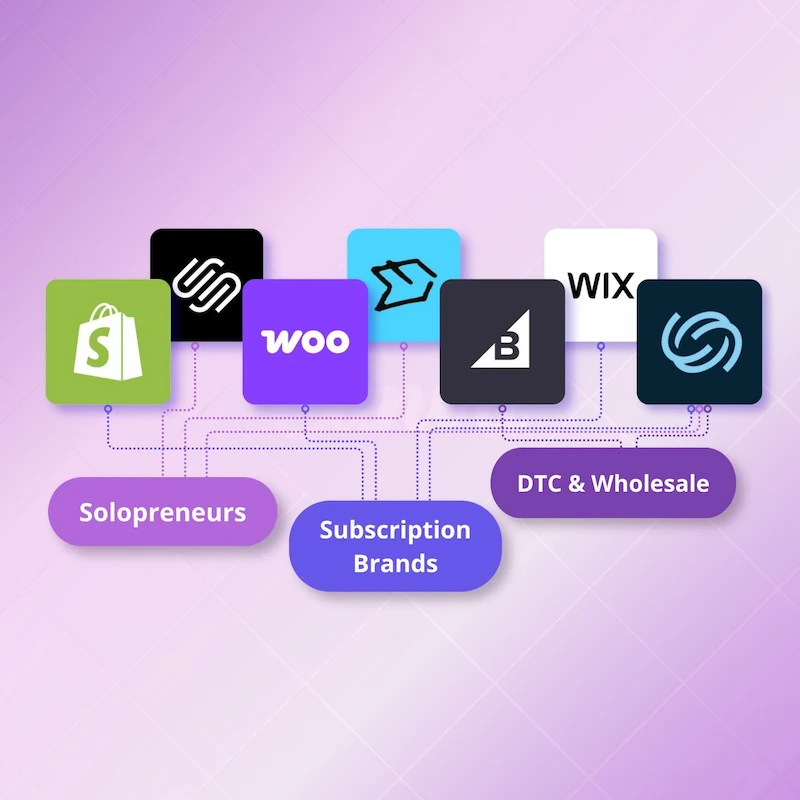
Seven platforms enter — Shopify, WooCommerce, BigCommerce, Squarespace, Wix, Big Cartel, and Merchant Tech. Five questions about your business knock them out one by one. By the end, most readers are left with one or two realistic options, because the truth most comparisons avoid is that for any specific business, most platforms aren't actually in the running. Some can't run your business model at all. Others can, but only with costs or technical demands that disqualify them in practice.
One disclosure upfront: Merchant Tech publishes this comparison. We've included the questions that eliminate us too — you'll find them below, stated as plainly as the ones that eliminate everyone else.
How This Ecommerce Platform Comparison Works
Answer five questions in order. Each one removes platforms from your list — either because they lack the capability entirely, or because getting it requires spending or expertise that changes the equation. Platforms eliminated by an earlier question stay eliminated.
The questions are sequenced by how decisively they cut. Capability gaps come first, because no price or feature list matters if a platform can't run your business model. Cost and operational fit come later, once the field has narrowed.
Pricing and feature information verified from live platform pages, July 2026.
Question 1: Do You Sell — or Plan to Sell — Subscriptions?
Recurring revenue is the sharpest dividing line in ecommerce platforms, which is why it's the first question.
If yes, eliminated: Big Cartel. It has no subscription billing, native or otherwise. A subscription business cannot run on it at any price.
Flagged, not eliminated: Shopify, BigCommerce, and WooCommerce all support subscriptions — through apps. Shopify offers a free first-party app for basic cases, though merchants with advanced needs often move to a paid app like Recharge. BigCommerce requires a third-party app (typically $50–$100/month). WooCommerce requires the WooCommerce Subscriptions plugin at $279/year. None of these disqualify a platform, but each adds cost and a vendor to manage.
Unaffected: Squarespace, Wix, and Merchant Tech include subscription billing natively.
If no, everyone survives. Move on.
Question 2: Do You Sell Wholesale or B2B?
Wholesale — custom price lists, B2B catalogs, net payment terms — is either built into a platform's architecture or it isn't. It can't be meaningfully bolted onto a website builder.
If yes, eliminated: Squarespace, Wix, and Big Cartel. None offer real B2B catalog support. Workarounds exist (duplicate storefronts, discount codes standing in for wholesale pricing), but they break down quickly as wholesale accounts multiply.
Flagged: Shopify. Native B2B lives on Shopify Plus, which starts at $2,300/month on a three-year term. Below Plus, wholesale runs through third-party apps on the Advanced plan ($299/month) — workable, but it typically means several hundred dollars a month in plan and app fees combined. (Verified: shopify.com/pricing, July 2026.)
Unaffected: BigCommerce (strong native B2B on higher tiers), WooCommerce (via B2B plugins, with developer help), and Merchant Tech (unlimited B2B catalogs included at $79/month).
If no, everyone still standing survives.
Question 3: Do You Have a Developer — On Staff or On Retainer?
This question exists for one platform.
If no, eliminated: WooCommerce. It's the most capable and customizable platform in this comparison, and it requires comfort with WordPress, hosting management, plugin compatibility, and troubleshooting. When something breaks, fixing it is your responsibility. For a business with a developer, that's control. For a business without one, it's risk. There is no version of WooCommerce that removes this requirement.
If yes, WooCommerce survives — and becomes a serious contender, because it's the only option with full code ownership and no platform-imposed limits.
No other platform is affected by this question.
Question 4: Are You Processing More Than a Few Hundred Orders a Month?
Order volume separates platforms built for commerce operations from platforms built for websites that also sell.
If yes, flagged toward elimination: Squarespace and Wix. Both can technically process high volume, but merchants commonly report their inventory, fulfillment, and reporting tools straining as order counts climb into the hundreds per month. Squarespace also caps catalogs at 10,000 products. Neither platform fails suddenly — they get gradually harder to operate, which is its own kind of elimination.
Also flagged: Big Cartel (if it's still standing), which is deliberately built for small, focused catalogs and offers limited tooling for high-volume order management.
Unaffected: Shopify, BigCommerce, WooCommerce, and Merchant Tech are all built to handle volume. The difference between them at scale is cost, not capability — BigCommerce's revenue thresholds can trigger automatic plan upgrades, and Shopify's app stack tends to grow alongside the order count.
If no, everyone still standing survives.
Question 5: Is Your Monthly Budget Under $30 — or Is Design Your Only Real Priority?
This is the question that eliminates us.
If yes, eliminated: Merchant Tech. At $79/month flat, Merchant Tech is more platform than an early-stage or design-first business needs. A solo maker testing an idea is better served by Big Cartel at $15/month. A boutique brand where visual presentation matters more than commerce operations is better served by Squarespace, starting at $16–$23/month. (Verified: bigcartel.com/pricing, squarespace.com/pricing, July 2026.) The capabilities that justify Merchant Tech's price — wholesale catalogs, native subscriptions, tax automation, white-glove migration — go unused by these businesses, and paying for unused capability is exactly the mistake this comparison is designed to prevent.
Also relevant here: Shopify's real cost. Its $29/month entry price survives this question, but merchants should model the full bill — apps, payment fees, premium themes — before treating it as a budget option. The advertised price and the operating cost routinely diverge.
If no, everyone still standing survives — and you're ready to read your result.
The Results: Who Survives Each Path
Different answer combinations produce different survivors. Here are the most common paths:
Swipe to see more →
| Your answers | Platforms remaining |
|---|---|
| Subscriptions + wholesale, no developer | Merchant Tech, BigCommerce |
| Subscriptions + wholesale, developer available | Merchant Tech, BigCommerce, WooCommerce |
| Subscriptions only, high volume | Merchant Tech, Shopify, BigCommerce |
| No subscriptions or wholesale, high volume | Shopify, BigCommerce, Merchant Tech (WooCommerce with a developer) |
| Low volume, tight budget, simple catalog | Big Cartel, Squarespace, Wix |
| Design-first, focused product line | Squarespace, Wix |
Two patterns are worth noticing. First, the platforms that survive the complex paths (subscriptions, wholesale, volume) and the platforms that survive the simple paths (budget, design) barely overlap. There is no platform that wins every path.
Second, when two or three platforms survive your path, the tiebreaker is usually cost structure. Merchant Tech is $79/month with subscriptions, wholesale, and tax compliance included. Shopify and BigCommerce reach the same capabilities through plan tiers and app stacks, which typically cost more and involve more vendors — a trade some merchants accept for their larger ecosystems.
What To Do With Your Result
If you landed on one platform, your decision is made — verify current pricing and start a trial.
If you landed on two or three, price out your specific configuration on each: plan tier, required apps, and transaction fees at your volume. For a deeper feature-by-feature review of these platforms, see our guide to the best ecommerce platform for small business.
If Merchant Tech survived your path, the practical next step is a demo — and if you're switching from another platform, migration is free and white-glove, with your store live and selling throughout.
FAQ
Why use elimination instead of ranking platforms?
Rankings imply one platform is best for everyone, which isn't how platform fit works. A platform that ranks first for a subscription-and-wholesale brand may be unusable for a solo maker, and vice versa. Elimination surfaces the constraint that actually decides the choice for your business, rather than averaging across businesses that look nothing like yours.
Which ecommerce platforms can't run a subscription business?
Big Cartel is the only platform in this comparison with no subscription billing path at all. Shopify, BigCommerce, and WooCommerce support subscriptions through apps or plugins at added cost. Squarespace, Wix, and Merchant Tech include subscription billing natively.
Which platforms support wholesale or B2B selling?
Merchant Tech (included at $79/month), BigCommerce (native on higher tiers), Shopify (natively on Plus from $2,300/month, or via apps on lower plans), and WooCommerce (via plugins with developer support). Squarespace, Wix, and Big Cartel do not offer meaningful B2B capability.
Can a small business start on a cheap platform and switch later?
Yes, and for early-stage sellers it's often the right call. The key is checking the exit before you enter: what migration tools exist, what they cost, and how your SEO transfers. A well-executed migration with 301 redirects and transferred metadata typically preserves rankings — see our guide on how to migrate from Shopify without losing your SEO.
What if my business needs a niche third-party integration?
Then ecosystem size becomes a legitimate deciding factor, and Shopify's app marketplace — the largest in this comparison — is the strongest argument for choosing it. This is also one of the cases where Merchant Tech isn't the right fit: its capabilities are native rather than marketplace-based, so merchants dependent on specific third-party tools should verify compatibility first.
How current is the information in this comparison?
All pricing, plan structures, and feature availability were verified from each platform's live pages in July 2026. Ecommerce platforms update their offerings regularly — confirm current details with each provider before making a decision.

Kate Maruyama: Kate is a Senior Editor at Merchant Tech where she oversees content that helps merchants understand platform tools, optimize their online stores, and grow their businesses.


